
On April 1, 2026, the Institute of Chartered Accountants of India quietly changed the rules. For the first time in the profession's 77-year history, the ICAI revised its Code of Ethics to allow CA firms limited advertising — a move its president described as intended to help small and medium CA firms participate meaningfully in global collaborations on a level playing field.
For decades, a CA in practice was deemed guilty of professional misconduct if they solicited clients directly or indirectly by circular, advertisement, personal communication, or any other means — on the principle that a professional should command work by reputation rather than through promotional activities.
That era is over.
From April 1, 2026, Indian CA firms can finally advertise their services — within a structured ethical framework that permits digital presence, informational content, and professional visibility without crossing into solicitation.
The profession is entering a new era of visibility. And the first, most immediate tool every CA and tax consultant needs to claim that visibility is one most of them haven't updated since they qualified: their visiting card.

The CA Profession in India: Highly Respected, Structurally Constrained
As of 2025, there are 4,07,629 active members registered with ICAI, including both Associate and Fellow members, with over 10 lakh students enrolled in the CA course. India now has over 1 lakh registered CA firms, with 7 in 10 being solo practices — over 72% are single-partner proprietorship firms.
That means the overwhelming majority of practising CAs in India are essentially running independent professional businesses — managing their own client acquisition, their own reputation, and their own growth — with very little institutional marketing support.
And yet for most of this profession's history, they could not advertise.
CAs have had to mostly rely on relationships and referrals to market their services — a constraint that placed enormous weight on the quality of every in-person interaction. Every ICAI chapter meeting, every industry conference, every introductory client meeting was a high-stakes moment. You either made a strong impression, or you didn't.
The visiting card was the only tangible tool left behind after those conversations.
Which makes it remarkable that most CAs in India are still leaving behind a paper rectangle.
What a Paper Card Cannot Do for a CA's Practice
A paper visiting card for a CA carries your name, designation, firm name, phone number, and email. That's it.
Here's what a potential client — a business owner, a startup founder, an NRI with compliance queries — actually wants to know when they meet a CA for the first time:
- What services do you specialise in? Audit? GST? International taxation? M&A advisory?
- What kind of clients have you worked with?
- Can I see your LinkedIn profile or any publications?
- How do I book a consultation with you?
- What are you known for — beyond the initials after your name?
A paper card answers none of these questions. It gives a potential client your phone number and asks them to do all the work themselves: Google your name, find your website, navigate your services, and decide if you're the right CA for them.
More than 62% of active CAs already provide business advisory services beyond traditional compliance work. If your visiting card doesn't communicate your specialist positioning, you're competing on price and availability — not expertise.
A digital visiting card changes the entire dynamic.
What a Digital Visiting Card Does for a CA That Paper Cannot
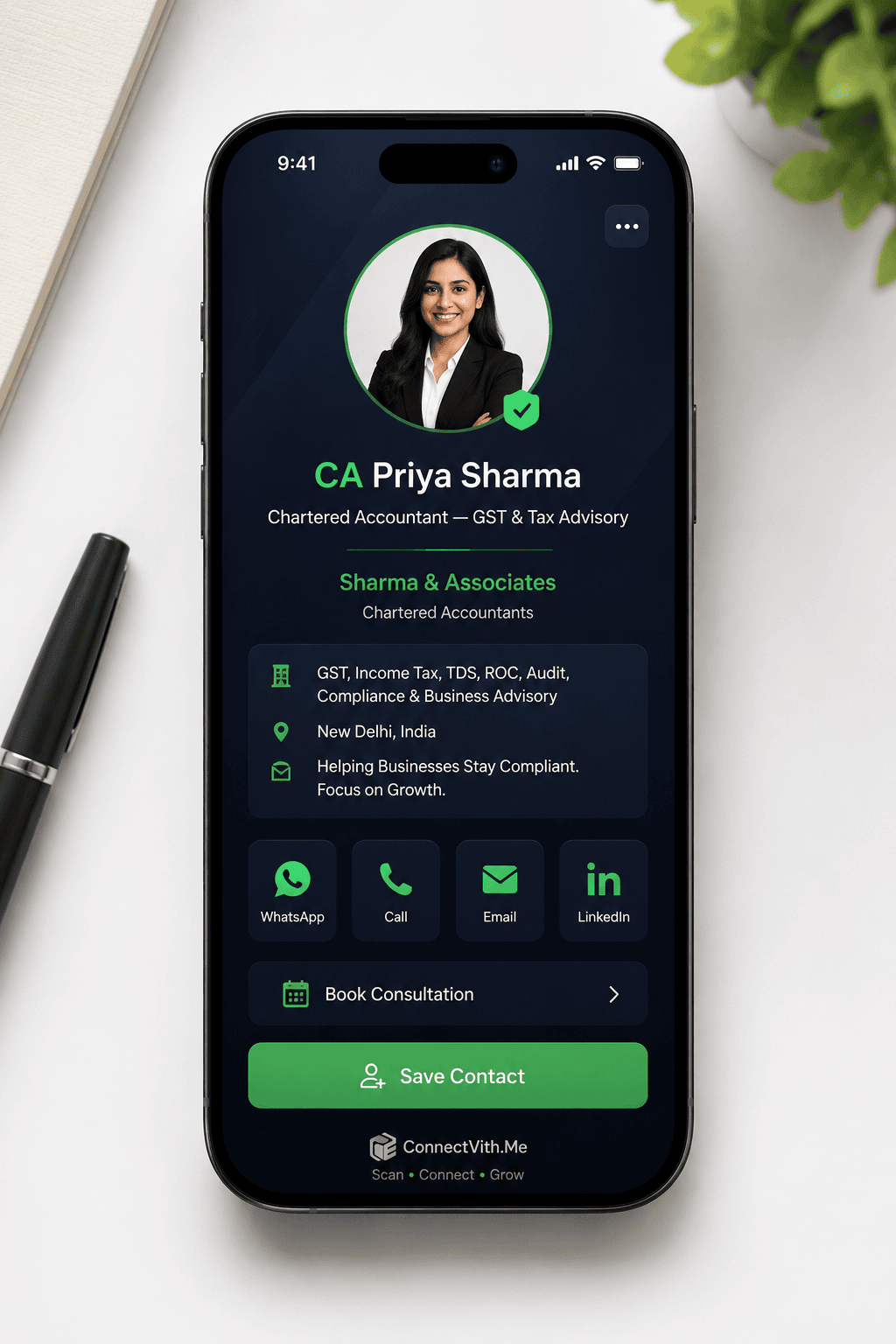
When you tap your ConnectVith.Me NFC digital business card on a client's phone, they immediately see a complete professional profile:
Your identity and positioning: Name, photo, firm name, and — critically — your specialist positioning. Not just "Chartered Accountant" but "GST advisory and audit for manufacturing MSMEs" or "International tax planning for HNIs and NRIs" or "CFO advisory for early-stage startups."
Your service areas: A clean list of the work you do, described in plain language that a business owner can understand and evaluate in 30 seconds.
One-tap contact: WhatsApp, phone, and email buttons — one tap to initiate a conversation. No typing, no hunting for your number.
Credibility signals: Links to your LinkedIn profile, your firm website, any ICAI publications or conference presentations, and Google Reviews from existing clients.
An appointment link: A "Book a Consultation" button linked to Calendly or your preferred scheduling tool — so an interested client can book a 30-minute call before they've even left the meeting.
A "Save Contact" button: One tap stores your details permanently in their phone — correctly spelled, with your photo attached, so you're findable when they need you.
For a profession that has historically relied entirely on relationships and referrals, this is a fundamental upgrade to the quality of every first impression.
Why April 2026 Changes Everything for CA Marketing
The ICAI's revised Code of Ethics, effective April 1, 2026, is a watershed moment. In a landmark reform, ICAI has allowed CA firms to advertise their services from April 1, 2026 — a move that enables brand building and allows young CAs specialising in areas like forensic accounting or sustainability audits to advertise these services and attract clients who specifically need such expertise.
The updated guidelines acknowledge that digital presence is no longer optional — it's essential for modern professional practice, and they move away from blanket prohibition toward a structured framework that permits websites, factual social media presence, and educational content.
For the first time, a CA can proactively build a professional identity — and a digital visiting card is the most immediate, tactile expression of that identity.
Think of it this way: your LinkedIn profile is your online presence. Your firm website is your digital office. Your NFC digital card is your in-person ambassador — the bridge between an offline conversation and your entire digital presence.
Every ICAI chapter event, every GST council seminar, every client referral introduction is now an opportunity not just to be remembered, but to be found, evaluated, and contacted — if your card does its job.
5 Specific Ways a Digital Card Builds a CA's Practice
1. You Communicate Your Specialisation Before You Say a Word
India's CA market is getting more competitive every year. As of October 2025, India has over 1 lakh CA firms, with over 72,000 being proprietorship firms — almost 90% led by first-generation entrepreneurs. In a market this crowded, generalist positioning is a race to the bottom on fees.
A digital card lets you encode your specialisation directly into your first impression. When a business owner taps your card and sees "Transfer Pricing and International Taxation for Indian Multinationals", they know immediately whether you're relevant to them — and they remember you specifically rather than as one of several CAs they met.
2. You Stay Compliant With ICAI's Updated Ethics Framework
The revised 2026 ICAI guidelines permit factual, professional digital presence — websites, informational content, service descriptions. A digital visiting card that presents your services factually, without comparative claims or testimonials that violate ethics rules, sits squarely within the permitted framework.
ConnectVith.Me's profile structure is designed for exactly this use case: professional information, service areas, contact details, and credentials — presented clearly and factually, without promotional language that could raise compliance concerns.
One practical note: Clause (7) of the Chartered Accountants Act still prohibits using any designation other than "Chartered Accountant" on professional documents, visiting cards, letterheads, or signboards, unless it is a legally recognised academic degree. Your digital card profile should reflect only ICAI-sanctioned designations — CA, FCA, ACA — alongside any legitimate academic qualifications.
3. You Capture Referrals More Effectively
Chartered accountants attract clients through word-of-mouth referrals, which are highly effective in building trust. But most referrals fail not because the recommender doesn't want to refer — they fail because the mechanics are broken.
"Here's my CA's number — he's excellent" works if the recipient saves the number correctly, spells the name right, and actually makes the call. Most of the time, they don't.
A digital card removes every point of failure. When your existing client taps your card and shares your profile link with a colleague over WhatsApp, that colleague receives a complete, professional profile with one-tap contact options. The referral converts because it's frictionless.
4. You Build a Lead Database From Every Event You Attend
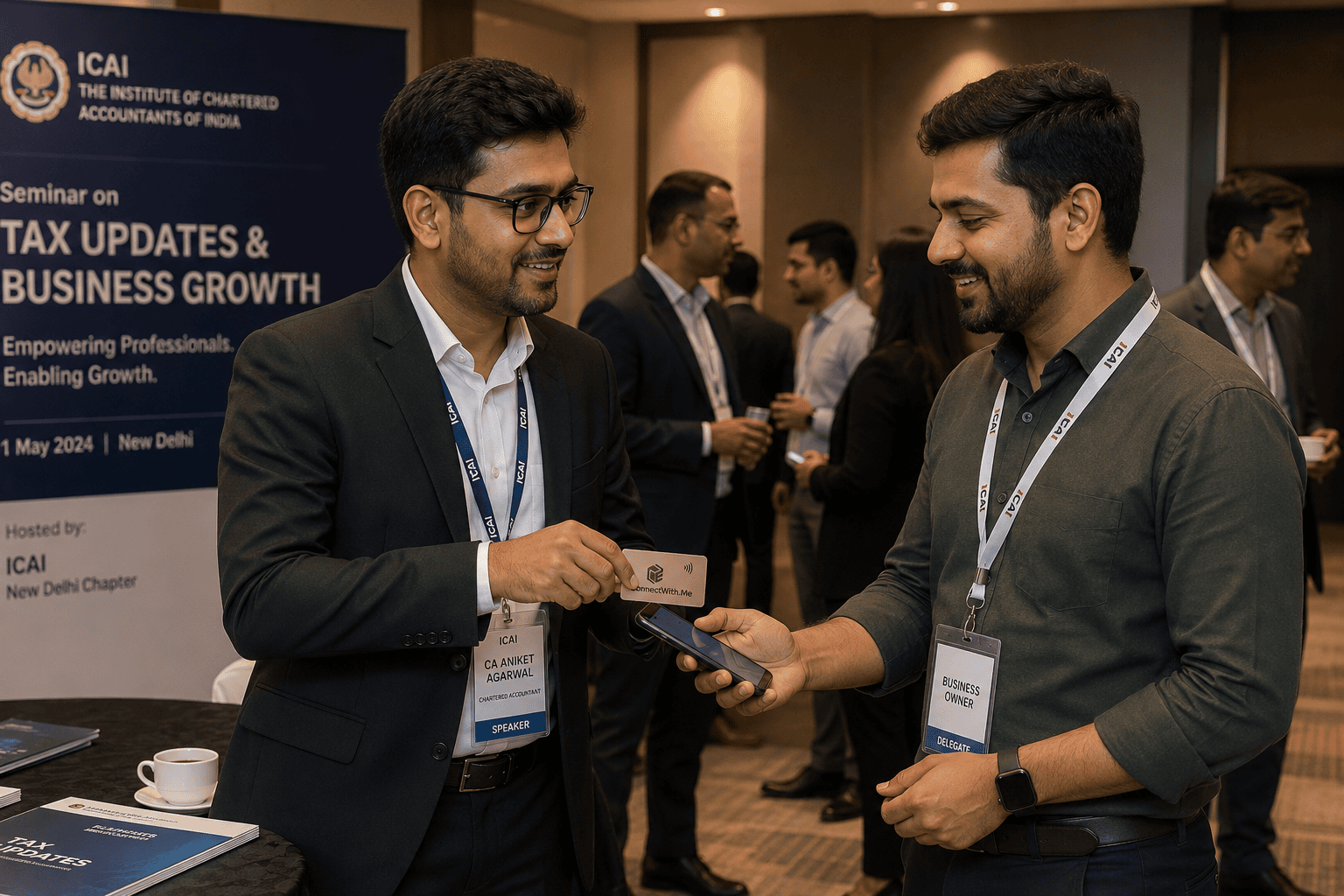
ICAI chapter events, industry seminars, tax conferences, CII and FICCI networking events — every one of these is a potential client acquisition opportunity. ConnectVith.Me's built-in lead capture means that when someone taps your card and submits their details, their name, phone, email, and company are logged automatically in your dashboard.
You end every event with a structured list of every person who engaged with your card — ready for follow-up the next morning, while your conversation is still fresh.
For a solo CA practice where every client counts, that systematic capture is the difference between a productive networking event and an evening that produces nothing trackable.
5. You Project the Professionalism Your Clients Expect
A CA's entire value proposition is built on the promise of precision, attention to detail, and trustworthiness. Every signal you send reinforces or undermines that promise — from the quality of your reports to the speed of your replies to, yes, the visiting card you hand over in a first meeting.
A client evaluating two CAs — one who hands over a creased paper card and one who taps a sleek NFC card that opens a polished digital profile — has already formed an impression before either CA has said a word about their qualifications.
That impression matters. Especially for high-value mandates — tax planning for HNIs, statutory audit for growing companies, CFO advisory for startups — where trust is the primary selection criterion.
What to Include in Your CA Digital Card Profile
A digital card is only as strong as the profile behind it. Here's exactly what every CA and tax consultant's ConnectVith.Me profile should contain:
Professional identity:
- Your photo — formal but approachable
- Full name with CA / FCA / ACA designation (ICAI-compliant only)
- Firm name and registered address city
Your specialisation line: One sentence that describes who you serve and what you do best. This is the most important line on your card — make it specific. "Tax and compliance for technology startups" is better than "Taxation services."
Contact buttons:
- WhatsApp (essential — most Indian client communication happens here)
- Phone
- LinkedIn profile
Credibility links:
- Firm website
- Any ICAI publications, articles, or conference talk recordings
- Google Business Profile (for reviews)
- Appointment booking link (Calendly or similar)
Service summary: A brief, factual list of your practice areas — Statutory Audit, GST Advisory, Income Tax, Transfer Pricing, Management Consultancy, etc. Keep it factual and ICAI-compliant.
Getting Started
Setting up your ConnectVith.Me NFC digital visiting card takes under 10 minutes:
- Create your profile — add your photo, designation, specialisation, and all contact links
- Choose your card — PVC (from ₹599), metal (from ₹1,499), or wood (from ₹999)
- Order — delivered to your door within 5–7 working days
- Go live immediately — your digital profile is active from the moment you sign up; share via QR code or direct link while your physical card is in transit
Every tap is tracked. You'll know how many times your profile was viewed, which links were clicked, and when — turning your networking into a measurable activity rather than a guessing game.
Conclusion
India has over 4 lakh chartered accountants and 1 lakh CA firms competing for clients in an increasingly crowded, increasingly digital market. For the first time in the profession's history, CAs can now actively build their professional visibility — and the tools to do it right are available at ₹599.
The most successful CAs of the next decade won't just be the most technically qualified. They'll be the ones who combine deep expertise with professional positioning — and who understand that every client relationship begins with a first impression.
Your visiting card is that first impression. Make it work as hard as you do.
Ready to upgrade your CA practice networking?Order your NFC digital visiting card → ConnectVith.MeExplore team plans for CA firms →