
⚡ Quick Answer A digital visiting card is an online profile that replaces your paper business card — shareable via NFC tap, QR code, WhatsApp, or web link, with real-time updates, analytics, and CRM integration built in. In India, the most powerful format is the NFC digital visiting card: a physical smart card that delivers your digital profile with a single tap on any smartphone. |
What Is a Digital Visiting Card?
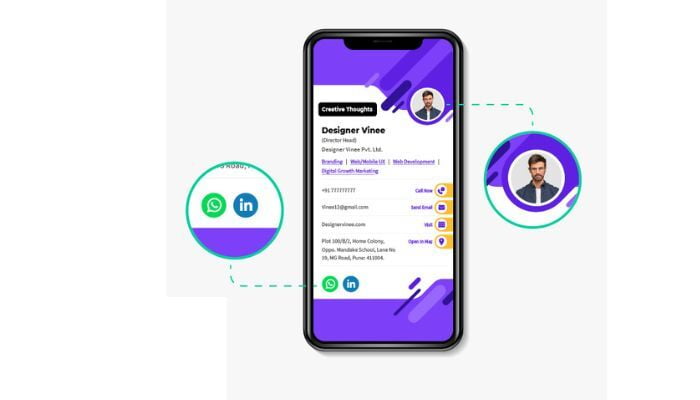
A digital visiting card, also known as an electronic business card or e-business card, is a digital version of a traditional paper business card. It can be shared electronically via email, WhatsApp, QR code, or NFC tap — and is stored online, not in someone's pocket or drawer.
Digital visiting cards offer many benefits over paper: they never run out, never become outdated, carry multimedia content, and generate analytics on who viewed and clicked them.
Types of Digital Visiting Cards — A Comparison
Not all digital cards work the same way. In 2026, there are four main types available in India. Understanding the differences helps you choose the right one for your professional context.
Type | How It Shares | Physical Card? | No-App for Recipient? | Best For |
NFC Card | Tap phone to card | Yes | ✔ Yes | In-person meetings, events, sales, enterprise |
QR Code Card | Scan code with camera | Yes / Print | ✔ Yes | Events, printed material, remote sharing |
App-Based Card | Share via app to app | No | ✘ App needed | Tech-savvy users in same ecosystem |
Link-Based Card | Share URL via WhatsApp/email | No | ✔ Yes | Remote, online, or email signature use |
ConnectVith.Me combines NFC + QR + Link in a single card — so one card covers every scenario above. See the full NFC card options →
NFC Digital Visiting Cards: India's Fastest-Growing Format
While QR codes and link-based cards have been common since 2020, NFC (Near Field Communication) cards have become the dominant choice for Indian professionals in 2025–2026. Here's why.
How NFC Cards Work
An NFC card contains a small microchip and antenna embedded in a standard PVC, metal, or wood card. When tapped against an NFC-enabled smartphone, the chip transmits a URL to the phone's browser — opening your digital profile instantly. No Bluetooth pairing, no app download, no internet on the card itself.
Compatible devices: All Android phones released after 2015, and all iPhones from XR (2018) onwards — covering over 700 million smartphones in India as of 2025 (Source: Ericsson Mobility Report 2025).
NFC vs QR: Which Is Better for India?
Both technologies have merit, but they serve different moments:
•NFC is instant and friction-free
•QR is the universal fallback
•ConnectVith.Me cards include both
For a detailed comparison: NFC Cards vs QR Code Business Cards in India →
Why India Is the Ideal Market for NFC Cards
Three factors make India uniquely suited for NFC card adoption at scale:
1. UPI familiarity — Indian professionals are already accustomed to tap-and-pay via UPI. Tapping an NFC card feels natural, not foreign.
2. 5G rollout — 5G availability across Tier 1 and Tier 2 cities means your digital profile loads in under a second after a tap, even at crowded events.
3. WhatsApp-first culture — ConnectVith.Me cards include a one-tap WhatsApp share button. After an in-person NFC tap, following up via WhatsApp is the default workflow for Indian sales professionals.
NFC Card Materials: PVC, Metal, or Wood?
ConnectVith.Me offers three NFC card materials at different price points:
•PVC (₹499) — Standard card weight and feel. Best for everyday professional use, bulk enterprise orders.
•Metal (₹1,499) — Premium weight and look. Signals credibility in high-stakes B2B, legal, and finance contexts. Laser-engraved branding.
•Wood (₹1,999) — Eco-friendly and distinctive. Best for sustainability-focused brands, designers, and creative professionals.
Full material comparison: Metal vs PVC vs Paper NFC Cards →
Benefits of Digital Visiting Cards
4. No reprinting — update your profile once; every future tap shows the new information
5. Analytics — see how many people viewed and clicked your card
6. CRM integration — leads auto-sync into Zoho, Salesforce, or HubSpot on tap
7. Cost savings — one NFC card costs less than two rounds of paper card printing
8. Eco-friendly — reduces paper waste; each card replaces 200–500 paper cards over its lifetime
9. Multimedia — embed video, portfolio links, booking pages, and social profiles
How to Create the Best Digital Visiting Card with ConnectVith.Me
Here is how to set up a professional ConnectVith.Me card that actually converts networking into contacts:
10. Use a professional headshot or clear company logo — not a logo-less or blank card
11. Include your WhatsApp link — this is the most-used follow-up channel in India
12. Add one strong CTA button — 'Book a Call', 'View Portfolio', or 'Download Brochure'
13. Enable the lead capture form — so recipients can submit their own details back to you
14. Connect your CRM before your first event — leads should flow in automatically, not be entered manually

ConnectVith.Me vs Other Digital Card Options
ConnectVith.Me is a dedicated digital card and NFC networking platform, not a design tool. Platforms like Canva and Vistaprint are for designing and printing paper cards — they do not offer NFC functionality, live profile updates, analytics, or CRM integration. Platforms like HiHello (US-based) offer digital cards but lack India-specific NFC card delivery, rupee pricing, and WhatsApp integration. For a detailed feature comparison, see: ConnectVith.Me vs HiHello →
What is a digital visiting card?
A digital visiting card is an online profile shareable via NFC tap, QR code, WhatsApp, or web link — no paper required.
Which is better — NFC or QR?
NFC is faster and more impressive for in-person use. QR works on all devices. ConnectVith.Me includes both on every card.
How much does a digital visiting card cost in India?
NFC cards from ConnectVith.Me start at ₹499 (PVC), ₹1,499 (metal), ₹1,999 (wood) — with free pan-India delivery. A digital-only profile is free to create.
Do I need an app to receive someone's NFC card?
No. Your browser opens their profile automatically on tap. Zero app download required.
Can I update my card after ordering?
Yes, unlimited times. The physical card stays the same; only the digital profile changes. No reorder needed.
Conclusion
Digital visiting cards are no longer a novelty in India — they are the professional standard for anyone who takes networking seriously. The NFC format